

Writing Skins is a reader supported author newsletter that shares excerpts from an award nominated speculative fiction writer’s craft journals. It offers a vulnerable, funny, and interesting look at the writing life, craft, and storytelling.
Shelves of the Future is the home of advanced reader copy book reviews. Readers looking for what books to pre-order next and what upcoming books to check out can read honest, uncommissioned reviews.
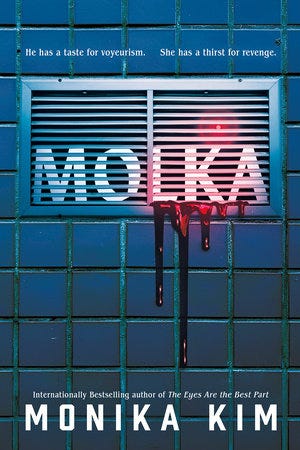
Monika Kim’s upcoming novel Molka builds off of Kim’s previous themes in her book The Eyes Are the Best Part. Themes of female injustice and family dynamics, except this time with a focus on the voyeuristic act of hidden cameras capturing women in private and intimate situations. An author’s note starts the book telling readers the history of the term molka in Korea and Kim’s motivation to writing the book:
“Molka is about the resilience of women, about how we resist and reclaim our dignity, and perhaps most importantly about female solidarity. Even in these troubling times, we have each other. And that means we always have hope.” - Molka by Monika Kim author note
This opening to the novel gave me so much hope and excitement to read how Kim would take this material and make it visceral and horrifying. But over the course of the novel, I became more disappointed. This review contains spoilers, so beware.
The novel is split in two point of views, one of Junyoung and the other of Dahye. Junyoung is your run of the mill pervert. He lives with his mom, who he verbally abuses, has hidden cameras installed in his office building, where he records women using the bathroom and masturbates to what he sees, and believes he can take and have any woman he wants. Dahye works in Junyoung’s building and is one of the victims of his hidden cameras and is in love with a rich celebrity, Hyukjoon, who makes her feel worthwhile and special in the shadow of her sister’s death.
Through these two different perspectives, the novel’s focus is on victimizing women and showing their powerlessness to men and the system around them. It also creates this binary where all men in the novel are bad and all women are easy targets and fall victim to powerful men. There are no characters that step outside these hard set lines and when they do, it is done in caricature and not from a root of a real character not stand ins for the countless victims and perpetrators out there.
The novel begins in Junyoung’s perspective, and it is a hard shift to go from Kim’s author note on solitary and women fighting together to a man violating women. The scene and all of Junyoung’s scenes are rife with lots of basic vulgar language used to describe the perverse. Junyoung’s character is surface and flat with little nuance or reveals. Lots of the generic ideas of why these men do this: because they have power and need to show women who’s in charge.
Okay, men crave power, yes, but what else?
I wanted to see how Kim explored deeper and unworn terrain that would explore the dynamics so often shown in these types of revenge stories. What about the self-hate festering in many abusers? Or the other side of villainous men and victimized women, men who have seen the light or fight against these systems and women who help uphold these systems or actively fight against them? What about victimized men of these abusive power systems? There are facets and shards and turns of these abuses that were not explored in Molka and that left me feeling like I’d read this story before and could see where it was going.
The rest of the opening goes on to introduce the other characters and lay ground for the later horror moments. These opening emotions, and many later throughout the novel, all read vapid and lacking of real feelings that penetrate past the page or set things up for anything unexpected to happen. I kept hoping that there would be something striking and new, but everything that happened was very expected. Then when it happened, nothing new or interesting was explored or shown. I never felt anything during the novel that made its moments stand out as a unique craft of fiction.
Dahye’s character is the one I thought I would find myself connecting with and rooting for but like all the other women in Molka, Dahye was portrayed as someone so weak and inferior that she always fell prey to men and hated other women, including her sister, Eunhye. Before the start of the novel, Eunhye killed herself after Dahye revealed that she was pregnant to their strict parents.
This early shame and death of her sister Eunhye is what pushes Dahye to pursue a romantic relationship with the rich and handsome Hyukjoon. She believes that his love will make her better and more appealing. She’s pressed on in this relationship by her best friend, Bora, who is another woman who believes men are the answer.
These three women: Dahye, Eunhye, and Bora are who I wanted the story to have focused on. Their love and care for each other, but what ended up happening was their relationships were pushed to the back of the novel and showed in mostly misogynistic ways. At one point, very uncharacteristically, Bora takes over Dahye sharing her story with the cops when she tries to report what happened with Hyukjoon. That moment, and many like it, felt like Kim’s way of giving examples of what happens to women in these situations, but that iron fisted hold on the themes made these moments and characters nothing more than painted stand-ins.
There was even a moment later in the story where Dahye, after a recording made by Hyukjoon of the two of them having sex without her knowledge is leaked, goes to a support group for women who have gone through the same. There are only two scenes with these other women and they are fast, Dahye doesn’t connect with them, and they are dismissive of Dahye and other women who have suffered this abuse.
No matter where Dahye turns everyone is either victim or abuser.
I think because the novel focused so heavily on the victimization of women, the emotions and motivations came across all really surface. Throughout the novel, I kept waiting for something new to jump out and happen. For the writing to push past the generic depictions of abuse we so often see (women are bitches and men are pigs). There weren’t any motivations that felt deeply rooted in character and felt like they only served the idea of the novel.
Nothing is new in Molka’s misogyny.
I tried really hard to figure out why the depictions of sexual assault and harassment felt off or done in an insensitive way, but they feel like intro to sexual assault and not as nuanced as I would like of this type of book. I want real emotion from these fictional characters but what comes across throughout the novel is caricature of emotions of real people. The events depicted do happen in the ways Kim has written them, but because of that, it makes Molka seem less like a novel and more like an attempt to collect injustices and fictionalize them.
The book does not read like a horror and the horror/supernatural aspect felt more forced. Throughout the novel, Dahye is haunted by a wet appairtion that takes most of the novel to fully materialize. Each time the haunting happened, Dahye kept writing it off like nothing was wrong or forgetting about it. In a way, this worked for building the self-distrust that builds in victims of manipulation, but reads as loosely written. There is a moment where Dahye sees an apparition that is clearly her dead sister but when it disappears the terror she was feeling is gone and it’s as if the moment never really happened.
When Eunhye’s spirit finally appears, it comes so late in the novel and has felt expected the whole way that the moment felt like a let down. There is some sweetness to her return, but the appearance of her brings so many things about the novel into question because Eunhye reveals that she’s known the entire time about Hyukjoon and had been trying to reach her to save her. This is never explained and other moments where Eunhye should still have that otherworldly insight, like about Junyoung stalking Dahye throughout the entire novel, she doesn’t share that information or doesn’t know it.
I wish more time was given to these sisters on the page, like it would be nice to have had the other POV be Eunhye and not Junyoung. But writing a ghost who is trying to reach her sister and seeing her go through pain and rape is harder to write than a pervert. It’s why I think the moment of reuniting between Eunhye and Dahye was so rushed, their apologizes and reasons quickly stated and moved on from.
By the end, the characters and novel begins to fall a part with more surface reactions and basic outcomes with lots of plot holes and things don't make narrative sense. Like Dahye being killed by a cop even though Eunhye is there and can do something about it but doesn’t. Or toward the end a line is repeated that doesn’t have much connection to the plot about pigs going to a slaughterhouse. And out of nowhere Bora has a car that she uses to kill Junyoung after Dahye’s death to pay him back for what happened to Dahye even though it’s not clear how she got a car or how she knows about Junyoung.
Not all of the novel was bad, however. There were one or two interesting and catching lines that caught me off guard. And for most of the novel up until the climax and resoultion, the writing was clear and flowed well. So well, it took me a day or two to read the entire book. Despite my issues with the character portrayals and handling of trauma, the novel was engrossing and while reading, I often found myself lost in the story and world. I think this has to do with Kim’s writing skill. Kim can carry a story but Molka was just not what I had hoped for: creepy, exciting, and vindicating.
So, should you read Molka?
Yes, of course you should. Kim is a great writer and the novel does add another book to the collection of these revenge narratives.
If you’re interested in reading Molka, the novel comes out April 2026 and you can pre-order directly from the publisher, Bookshop, or your local independent bookstore.
Will you be picking up Molka when it comes out?
Thanks for reading! Catching you in a couple of weeks for a review of Dead Weight by Hildur Knútsdóttir; translated by Mary Robinette Kowal.